Wednesday, October 13, 2010

Man Booker Prize 2010

Yesterday, the 2010 Man Booker Prize for Fiction was awarded to Howard Jacobson for “The Finkler Question”, published by Bloomsbury.

Julian Treslove, a professionally unspectacular former BBC radio producer, and Sam Finkler, a popular Jewish philosopher, writer and television personality, are old school friends. Despite a prickly relationship and very different lives, they’ve never quite lost touch with each other – or with their former teacher, Libor Sevcik, a Czech always more concerned with the wider world than with exam results.
Now, both Libor and Finkler are recently widowed, and with Treslove, his chequered and unsuccessful record with women rendering him an honorary third widower, they dine at Libor’s grand, central London apartment.
It’s a sweetly painful evening of reminiscence in which all three remove themselves to a time before they had loved and lost; a time before they had fathered children, before the devastation of separations, before they had prized anything greatly enough to fear the loss of it. Better, perhaps, to go through life without knowing happiness at all because that way you have less to mourn? Treslove finds he has tears enough for the unbearable sadness of both his friends’ losses.
And it’s that very evening, at exactly 11:30 pm, as Treslove, walking home, hesitates a moment outside the window of the oldest violin dealer in the country, that he is attacked. And after this, his whole sense of who and what he is will slowly and ineluctably change.
The Finkler Question is a scorching story of friendship and loss, exclusion and belonging, and of the wisdom and humanity of maturity. Funny, furious, unflinching, this extraordinary novel shows one of our finest writers at his brilliant best.

Tuesday, October 12, 2010

Back home, to excellent news

The last trip was quite long and tiresome, but it went very well. It didn’t left me much time for rest or reading, but it proves to be rewarding already. At my return home I was very happy to find, however, that finally the Swedish Academy decided to award the Nobel Prize for Literature to the great Mario Vargas Llosa. I read 6 of Mario Vargas Llosa’s novels and each one of them was a delight. I remember especially “La Ciudad y Los Perros” (The Time of the Hero) an excellent and complex novel, with multiple perspectives and sending the reader well on thought, “Pantaleon y Las Visitadoras” (Captain Pantoja and the Special Service), a novel entertaining and hilarious, and “Conversacion en la Catedral” (Conversation in the Cathedral), a novel that portrays Peru of 1950s and that together with Gabriel Garcia Marquez’s “El Otono del Patriarca” (The Autumn of the Patriarch), Augusto Roa Bastos’ “Yo, El Supremo” (I, The Supreme) and Alejo Carpentier’s “El Recurso del Metodo” (Reasons of State) form a quartet of novels related to dictatorship that always will stick with me. Congratulations to Mr. Mario Vargas Llosa! It is well deserved!

Wednesday, October 6, 2010

A new business trip

As I said last week, one of the results of my previous business trip was an upcoming new trip. Well, that time has come and today I will be leaving on that second business trip. So, once again for the next few days my blog goes silent a bit, remaining to resume its schedule next week on Monday or Tuesday, depending on my return. Anyway, one of the next week posts will be my review of Alden Bell’s “The Reapers are the Angels” since it is almost finished. Until then, take care of yourselves and have a great week :)

Tuesday, October 5, 2010

Book trailer - "Gauntlgrym" by R.A. Salvatore


One of my all time favorite characters is the legendary Drizzt Do’Urden. I have fond memories of Drizzt Do’Urden, but I have to be completely honest and say that I have a drawback too. I enjoyed the early novels featuring the dark elf, but after a while it seemed that his story overstretched, pulling on things that were better left aside. Therefore at a point I didn’t feel as eager to start reading a new adventure of Drizzt Do’Urden as I was before. That point was the “Transitions” trilogy, because although I bought all the three novels of the series, “The Orc King”, “The Pirate King” and “The Ghost King”, I didn’t read any of them. Today, Wizards of the Coast releases a new R.A. Salvatore’s novel featuring his famous character, Drizzt Do’Urden. I still have the character in my heart, I will always have him, and the book trailer looks very good, but I am not exactly sure when I’ll be reading “Gauntlgrym”. I will definitely buy R.A. Salvatore’s “Gauntlgrym” because I am sure that one day it will come the turn of all these unread Drizzt Do’Urden novels to find their way on my reading table. Still, I am saddened to see that Drizzt becomes a bit too commercial for my liking.

Monday, October 4, 2010

Cover art - "The End of the World" (Sfîrşitul Lumii) edited by Martin H. Greenberg

I am happy to see that the small Romanian publishing house, Millennium Press, continues to support the speculative fiction market, releasing a mix of interesting titles by local and foreign writers. Another praiseworthy work done by Millennium Press can be seen on the covers of their releases, kept on a constant high level lately. One of the Millennium Press future releases is the anthology edited by Martin H. Greenberg, “The End of the World”, which was published in the US on July this year by Skyhorse Publishing. The cover artwork chosen by the Millennium Press for the Romanian edition of “The End of the World” (Sfîrşitul Lumii) looks great, very appropriate for the subject in question and with an atmosphere that is equally disturbing and uncomfortable. The artist of the artwork is Ehsan Dabbaghi and I have to say that until now I was unaware of his works. But I am happy that this wonderful cover also made me discover Ehsan Dabbashi, because the works I saw on his CG Society portfolio are truly impressive.

Saturday, October 2, 2010

Titles spotlight - "The Apex Book of World SF" volume 2 & "Down These Strange Streets"

I am always behind with my readings, not in a deadline term but in a desire to explore many titles that truly appeal to me. Two such titles came back into focus these days, two anthologies on which I set my eyes for some time, but for different reasons ended up unread so far. “The Apex Book of World SF” edited by Lavie Tidhar is waiting patiently for its turn although I have a review copy for quite a while now, while for “Warriors” edited by George R.R. Martin and Gardner Dozois I am still pondering if I should wait for the release of the paperback edition or buy the hardcover now. The reason for these two anthologies coming into focus in full force is that the editors of these collections announced the Table of Contents for two similar projects.

Lavie Tidhar, the editor of “The Apex Book of World SF”, announced the table of contents for the second volume of the anthology, due to be released by Apex Book Company in mid-2011:
"Alternate Girl’s Expatriate Life" by Rochita Loenen-Ruiz (Philippines)
"Mr. Goop" by Ivor W. Hartmann (Zimbabwe)
"Trees of Bone" by Daliso Chaponda (Malawi)
"The First Peruvian in Space" by Daniel Salvo (Peru)
"Eyes in the Vastness of Forever" by Gustavo Bondoni (Argentina)
"The Tomb" by Chen Qiufan (China)
"The Sound of Breaking Glass" by Joyce Chng (Singapore)
"A Single Year" by Csilla Kleinheincz (Hungary)
"The Secret Origin of Spin-man" by Andrew Drilon (Philippines)
"Borrowed Time" (trans. Daniel W. Koon) by Anabel Enriquez Piñeiro (Cuba)
"Branded" by Lauren Beukes (South Africa)
"December 8" by Raúl Flores Iriarte (Cuba)
"Hungry Man" by Will Elliott (Australia)
"Nira and I" by Shweta Narayan (India)
"Nothing Happened in 1999" by Fábio Fernandes (Brazil)
"Shadow" by Tade Thompson (Nigeria)
"Shibuya no Love" by Hannu Rajaniemi (Finland)
"Maquech" by Silvia Moreno-Garcia (Mexico)
"The Glory of the World" by Sergey Gerasimov (Ukraine)
"The New Neighbours" by Tim Jones (New Zealand)
"From the Lost Diary of TreeFrog7" by Nnedi Okorafor (Nigeria/US)
"The Slows" by Gail Har’even (Israel)
"Zombie Lenin" by Ekaterina Sedia (Russia/US)
"Electric Sonalika" by Samit Basu (India)
"The Malady" (trans. Wiesiek Powaga) by Andrzej Sapkowski (Poland)
"A Life Made Possible Behind The Barricades" by Jacques Barcia (Brazil)
The second volume looks very interesting indeed, with a few familiar names and other writers who are waiting to be discovered. But until the publication of the second novel I moved the first one at the top of my reading list.

George R.R. Martin announces on his blog that together with Gardner Dozois he completed the work on another anthology, “Down These Strange Streets”, due to be released by Penguin Putnam, at an unknown date for now . As George R.R. Martin says on his post: “Down These Strange Streets” is another of our crossgenre projects, this one a mix of fantasy, science fiction, urban fantasy, hardboiled mystery, historicals, and private eye stories.
"The Bastard Stepchild" (introduction) by George R.R. Martin
"Death by Dahlia" by Charlaine Harris (a True Blood story)
"The Bleeding Shadow" by Joe R. Lansdale
"Hungry Heart" by Simon R. Green
"Styx and Stones" by Steven Saylor (a Gordianus story)
"Pain and Suffering" by S.M. Stirling
"It’s Still the Same Old Story" by Carrie Vaughn
"The Lady is a Screamer" by Conn Iggulden
"Hellbender" by Laurie R. King
"Shadow Thieves" by Glen Cook (a Garrett story)
"No Mystery, No Miracle" by Melinda Snodgrass (an Edge story)
"The Difference Between a Puzzle and a Mysery" by M.L.N. Hanover
"The Curious Affair of the Deodand" by Lisa Tuttle
"Lord John and the Plague of Zombies" by Diana Gabaldon (a Lord John novella)
"Beware the Snake" by John Maddox Roberts (a SPQR story)
"In Red, With Pearls" by Patricia Briggs
"The Adakian Eagle" by Bradley Denton (novella)

Friday, October 1, 2010

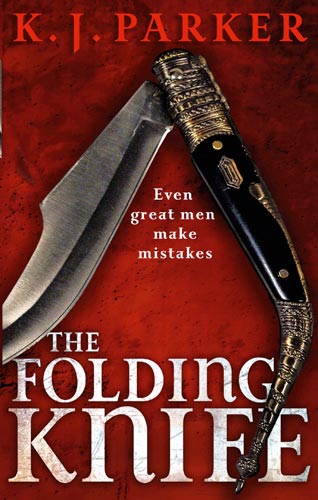
"The Folding Knife" by K.J. Parker

"The Folding Knife"
Format: Paperback, 528 pages
Publisher: Orbit Books
Review copy received through the courtesy of the publisher, Orbit Books

Basso the Magnificent. Basso the Great. Basso the Wise. Basso the Murderer. The First Citizen of the Vesani Republic is an extraordinary man.
He is ruthless, cunning and, above all, lucky. He brings wealth, power and prestige to his people. But with power comes unwanted attention, and Basso must defend his nation and himself from threats foreign and domestic. In a lifetime of crucial decisions, he’s only ever made one mistake.
One mistake, though, can be enough.

Bits and pieces of information are leaking from time to time about K.J. Parker, but most of the presence of this author remains under a veil of mystery. I admit that I am a bit curious about who K.J. Parker is, but rarely am I bothered by my curiosity because it is a while now since I fell in love with her (most of the sources I found refer to K.J. Parker as a female) works. Without having a problem with the mystery surrounding K.J. Parker I gladly opened the front cover of her latest novel, “The Folding Knife”.

Once again K.J. Parker proved, if that was still necessary, to be an intelligent, careful and talented writer. She crafts a world and a story that without the secondary world elements will seem to be a historical recollection or a biography. K.J. Parker lays strong foundations to her creations, world, character and story, building from there without the fear of the novel crumbling on itself at the first logical question. “The Folding Knife” is not a fast moving novel, on the contrary it will seem to crawl, but that doesn’t reap anything from the enjoyment of the reader, because the novel keeps a steady and natural course, moving constantly forward without uneventful parts or falls into stereotypy.

The story gravitates around the main character, Bassianus Severus shortly known as Basso, the only major presence of the novel. Since it is the story of his life, or more exactly a part of his existence, it cannot be otherwise. The reader learns of the fate of Basso even from the introductory part, but the journey that leads the character to that point is as interesting as it is unpredictable. However, once the story reaches the same point it doesn’t simply end, but it extends into every reader’s imagination, Basso’s fate being far from sealed with the end of the novel. Basso is an ambitious, cunning and selfish character, but his flaws as much as his qualities are making his presence so much stronger. Basso is not a positive character, but not a negative one either, he just acts according to his principles and interests. K.J. Parker helps her character develop with the relationships that Basso has with a few other characters, the influence that he has on them and they on him. Although Basso’s relationship with his sister goes as an undercurrent it is the most important one, stretching in many directions and affecting Basso’s development and actions in many occasions.

The side characters do not rise at the level of Basso, but help the reader look at the events in which the main character isn’t involved directly. Because every little event, involving or not the main character, has effects on his actions and further development of the story in one way or the other. Piece of information or events that seem to have no importance will prove to be a sequence of a mesmerizing butterfly effect that takes place in “The Folding Knife”. Through the characters of the novel we can see a few interesting threads on politics, economics, society and war, touched on philosophical level and tickling the mind of the reader. I especially liked the correspondence between Basso and Bassano, his nephew, a series of letters towards the end of the novel that present some interesting concepts on war and humanity.

The setting of “The Folding Knife” is a world resembling the ancient Roman civilization in its republic phase. The work on the setting is truly impressive, K.J. Parker treating every detail with great attention, regardless of the importance of its role. Historical, political, military, economical, demographical or religious each of these aspects makes their presence felt and bring the Vesani Republic and the world around it fully into existence. The economy is the most important wheel of this assembly, the author throwing a light on the public, private and social sectors and the important part played by services and finances on these sectors. There are a few times when the economical part might be confusing, but once I went over the respective part again things became clear again and in the wide perspective revealed by the further reading they became clearer.

“The Folding Knife” has no action that emphasizes on physical qualities, but that should not drive readers away from this novel. As life offers smaller or bigger events each day so is “The Folding Knife”, with something happening with each page and chapter. As for the author of the present novel, I read enough of her works to say that every list of top genre writers would not be complete without K.J. Parker’s name on it.